
EPECoarse cells, soft and light
Materials
Choosing between the four
We do not think of the Essential as the lesser one. All four are foams we make ourselves, each suited to different situations, and explaining the difference clearly matters more.
| Item | Essential EPE | Advanced XPE 30× | Premium iXPE | Signature Cloud-Soft POE |
|---|---|---|---|---|
| Feel | Soft and light, easy to move and store | Firm and supportive, no sinking underfoot | Springy with fast rebound, cushions better than XPE | Best shock absorption, the softest underfoot |
| ST safety toy mark | NoneDeliberately not obtained; see the note below | Yes | Yes | Yes |
| Skin | Water-based antibacterial PU | Water-based antibacterial PU | Water-based antibacterial PU | Water-based antibacterial PU + silicone |
| Best for | Budget first; the crawling year or two | The everyday mat for crawling and playing on all day | The best feel and cushioning, budget permitting | The strengths of all four in one; or when you need a custom size |
| Over time | Gradually compacts under long, heavy loadsPlanning on two years or more? Go straight to the Advanced | Our own sample still measures 4 cm after five years | Finer, more even cells than XPE, just as pressure-resistant | The best rebound of the four |
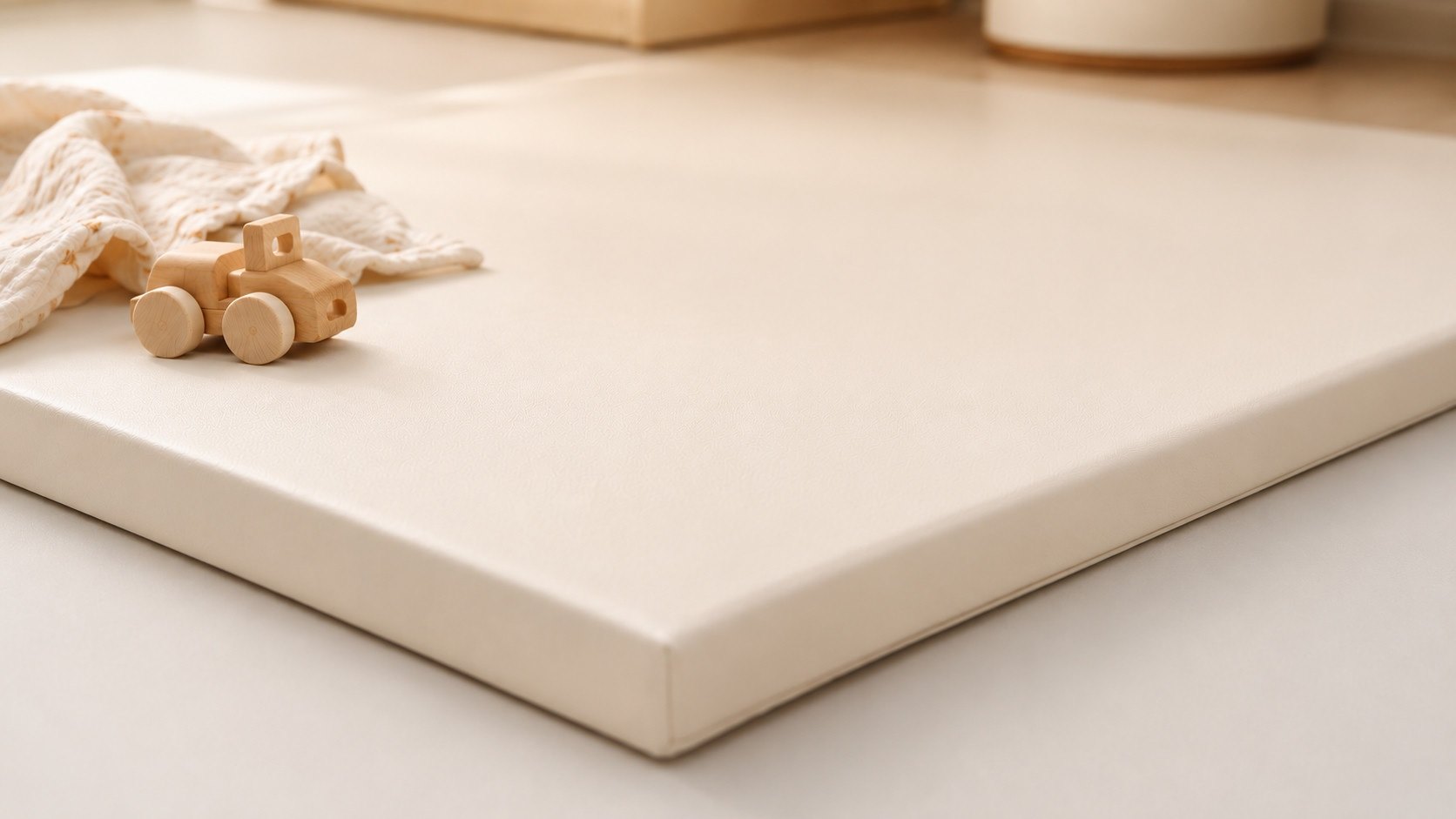
| Thickness | 4 cm | 4.0–4.5 cm | 4.0–4.5 cm | 4.0–4.5 cm |
| Surface | All four have a five-section seamless top | |||
The Essential was submitted for every test except flame resistance, and passed every one. It has no ST mark because EPE would need an added flame retardant to pass, and we chose not to add one. That is a choice, not a limitation.
About the materials
First, one term: expansion ratio
The same kilogram of raw material can be foamed into a small block or a big one. The more it expands, the more volume you get, the lower the cost, and the coarser the cells inside.
How much it expands is the expansion ratio. A lower ratio means more material packed in, finer cells, and a mat that is harder to flatten.
Most XPE on the market is 35×. Our Advanced mat uses 30×. Those 5 points make a real difference underfoot and in durability.
The price gap comes from here too. EPE costs roughly half as much to foam as XPE, and we know that for certain because we foam both ourselves. So the Essential mat is cheaper because the material is different, not because corners were cut.
XPE 35×Common on the market
XPE 30×Our Advanced mat
iXPEElectron-cross-linked, fine honeycomb cells
How to see it yourself
You do not have to take our word for it; look at a cross-section yourself. One warning first, though, because it will mislead you:
A single close-up photo cannot tell you how big the cells are.
Coarse cells shot up close and fine cells shot from further away look almost identical on screen. So no single close-up can be used to judge a material, including ours.
To compare, they have to be in the same frame.

What the layer lines in the cross-section are
When you cut it open you see a few faint lines: those are where the layers of the multi-layer structure join. We heat-bond them, fusing layer to layer with heat, with no glue.
Honestly, though, you cannot easily tell heat-bonded from glued layer lines in a photo. So we will not ask you to judge by that. Ask the seller how the layers are joined; it is quicker.
About thinning over time
It happens, but it depends on the material.
Once EPE is compressed it does not come back. This is not a quality issue but the structure of the material: a burst cell is burst and cannot recover. A 4 cm EPE mat walked on daily with furniture on it is often under 3 cm a year later.
XPE has fine cells and thick walls and springs back when pressed. The 30× XPE sample we kept still measures 4 cm after five years.
That is our own long-term record, not lab data. You can measure yours too: a ruler at all four corners beats anything else.
Why the Essential mat has no ST mark
Three mats have it; the Essential does not. No dancing around it: it comes down to the flame resistance test.
We test to the toy standard, because it is the strictest and because children lie on the mat all day and put the corners in their mouths. The Essential mat's heavy metal, plasticiser, formamide, mechanical and physical tests were all submitted and all passed.
Only flame resistance was not submitted, because we knew it would not pass. XPE, iXPE and POE are dense enough to pass on their own; EPE has a high expansion ratio and an airy structure, so it burns fast by nature.
The only way to get EPE through is to add flame retardants, which are extra chemical additives.
We chose not to.
For a mat that a baby lies on all day and chews on, we believe what you would have to add for the sake of a mark carries more risk than it solves.
So the Essential mat has no ST mark, and we do not intend to get one. That is a choice, not a limitation: we foam the material ourselves and know exactly what goes in.
The skin: the layer your child actually touches
The foam decides feel and durability, but the skin is what gets touched, crawled on and wiped every day.
The Essential, Advanced and Premium mats use water-based antibacterial PU. Water-based means no organic solvents in the process, which is also why our mats have almost no smell.
The antibacterial figures were measured on the skin material itself: under GB/T 31402-2023, over 99.9% against E. coli and Staphylococcus aureus and 99.7% against Candida albicans. Report numbers and details are in the testing section below.
The Signature Cloud-Soft mat has the same water-based antibacterial PU with an extra layer of silicone on top: gentler on skin, plusher and silkier, and more durable and resistant to ageing.
Both skins can be replaced on their own, so a tear does not mean buying a whole new mat.
Why Cloud-Soft costs more
The first three mats are all foamed PE, differing in expansion ratio and cross-linking. Cloud-Soft is different: POE is not PE at all.
It is a polyolefin elastomer, and the raw material itself costs far more. So Cloud-Soft is expensive mainly because of the material, not the foaming process. For the same reason it is what premium mattress support layers and running shoe midsoles use.
Underfoot that means support, rebound and cushioning all at their best at once; the other three each trade something off, POE does not.
And both layers of Cloud-Soft are different. The core is POE, and the skin adds a silicone layer over the water-based antibacterial PU.
Safety
POE's structure needs no plasticisers, and the material contains no halogens.
Testing
The children's play mat (five-fold seamless) carries the ST safety toy mark, certificate 114-G12592-40999, valid until 16 October 2028.
Issued by the Taiwan Toy and Children's Products R&D Center (TCC), report 11410079CSB511-1, assessed as compliant.
The ST mark covers the Advanced (XPE), Premium (iXPE) and Signature Cloud-Soft (POE) mats. The Essential (EPE) is not included, but to be clear: apart from flame resistance, every test was submitted and passed for the Essential mat; the only difference is that one test, explained in the section on why the Essential has no ST mark.
Not just the foam: five parts tested separately
A mat is more than foam. The report samples the plastic skin, foam, plastic zip, fabric edge and metal zip pull separately and tests each on its own.
| Test | Standard | Result |
|---|---|---|
| Flame resistance | CNS 4797-1 | Compliant |
| Migration of eight heavy metalslead, cadmium, barium, chromium, mercury, selenium, antimony, arsenic | CNS 4797-2 | All five parts far below the limits |
| Mechanical and physical | CNS 4797-3 | Compliant |
| Six plasticisersphthalates | CNS 15138-1 | Not detected in the skin or foam |
| Formamide | CNS 15493 | Not detected |
Formamide: not detected
Formamide is the substance most often discussed for foam mats. The CNS 15493 limit is 200 mg/kg; our foam tested as not detected (method detection limit 1 mg/kg).
The iXPE raw material also has a separate CTI report (A2260018620101001C), testing formaldehyde under EU Toy Safety Directive 2009/48/EC and formamide under GB/T 42805-2023: both not detected.
Antibacterial skin
Test report for the water-based antibacterial PU raw material (CTI, A2250617705101C, under GB/T 31402-2023):
This is a report on the skin material, supplied by the material supplier and tested on the raw material, not the finished mat. We state the source as it is.
| Organism | Antibacterial rate |
|---|---|
| E. coliATCC 8739 | >99.9% |
| Staphylococcus aureusATCC 6538 | >99.9% |
| Candida albicansATCC 10231 | 99.7% |
Side ventilation holes
The Essential EPE, Advanced XPE and Premium iXPE mats have rows of ventilation holes along the sides so air can circulate inside the mat; the difference is most noticeable when it is stored standing against a wall.
All the holes are on the sides. The surface you step on and wipe is still one solid piece with no openings, so crumbs cannot fall in and there are no little holes you cannot clean. The Signature Cloud-Soft (POE) keeps its silicone-wrapped edge with no ventilation holes.
The upgrade is rolling out gradually and the version shipped depends on stock; message us before ordering if you specifically want the ventilated version.

Side view: ventilation holes on two colours. Even spacing and diameter, with no openings on the top surface.
Frequently asked questions
- What is the difference between Essential and Advanced?
- The material. Essential is EPE, with coarse cells, soft and light; Advanced is high-density XPE at only 30× expansion, with fine, firm cells that resist thinning under long-term pressure. Same thickness.
- XPE or iXPE?
- Same thickness; the difference is how fine the cells are. iXPE is electron-cross-linked, with finer, more even cells and better cushioning and rebound than XPE. On a budget, the Advanced XPE is just as durable and just as safe.
- Is POE silicone?
- No. POE is the foam core of the Cloud-Soft mat, and it is not PE either; it is a different material that costs far more and is common in premium mattresses and running shoe cushioning. The silicone is the outermost layer: a silicone layer over the water-based antibacterial PU, which is what sets it apart from the other three (whose skin is water-based antibacterial PU only).
- Does it smell?
- Almost not at all. Play mat smells usually come from two places: low-grade foam or solvent-based skin finishing, and we use neither. The skin is water-based PU (with a silicone layer on the Signature), with no organic solvents in the process. The foam tested not detected for both formamide and formaldehyde, with reports in the testing section. If you notice any smell that seems wrong after unpacking, just tell us.
- What if the skin tears?
- The skin can be replaced on its own; you do not need to buy a whole new mat.
- Can you make custom sizes?
- Yes, quoted by size. Six colours: mocha cream gradient, cream white, grey & cream, chic grey, cocoa and cocoa & cream, and two-tone is possible too. Delivery about a week after it is made, because we foam the material ourselves and do not wait on a supplier's schedule.
Every mat opens up
You do not have to ask us what is inside; open the zip and look. We do not think that takes courage; it should simply be normal.


All four strips are cropped from the same photo, same light, same distance, so you can compare the cells directly.
Kids do the growing,
we do the cushioning.
4.5CM
Made thickness|measured range 4.0–4.5 cm
The foam layer is elastic, so measurements differ between at rest and under load; 4.0–4.5 cm is the normal range. The impact of a sit-down fall is spread through the mat instead of reaching your child's knees and the back of the head.
Four materials
From Essential to Signature,
same testing, different cushioning
All four pass heavy metal, plasticiser, formamide and mechanical tests, and none contain flame retardants. Moving up the range buys better cushioning and rebound, in other words how much the mat catches when a child falls.
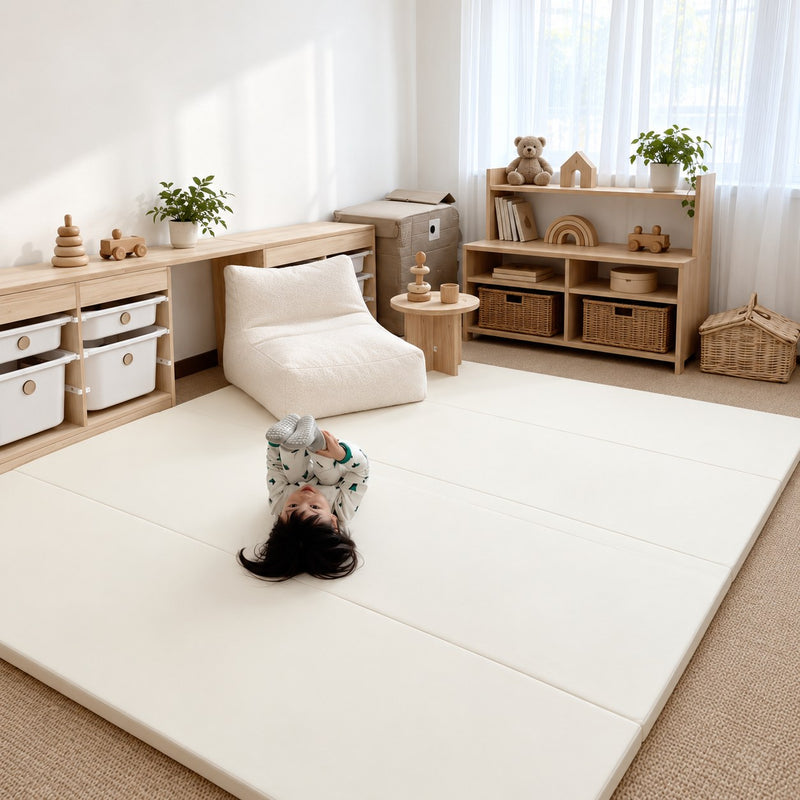
Essential
EPE Essential
NT$ 2,400 – 2,980
Soft and light, the first mat for the rolling-over months
4 cm thick · PU surface
5 sizes × 6 colours
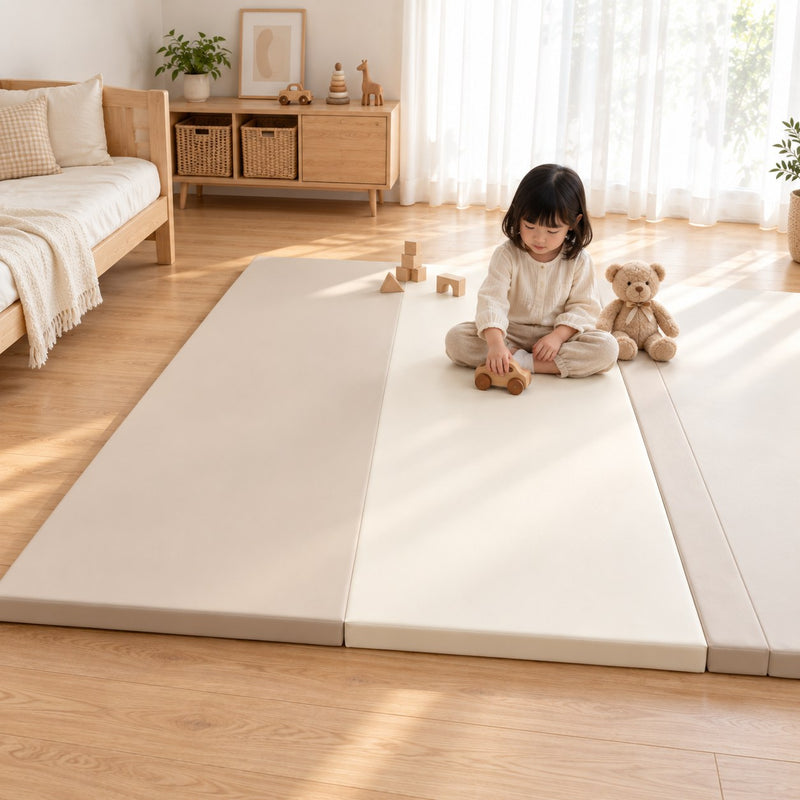
Advanced
XPE Advanced
NT$ 2,580 – 4,180
Firm and never sags, keeps its shape through a whole day of crawling
4.5 cm thick · 30× high-density true XPE
4 sizes × 6 colours
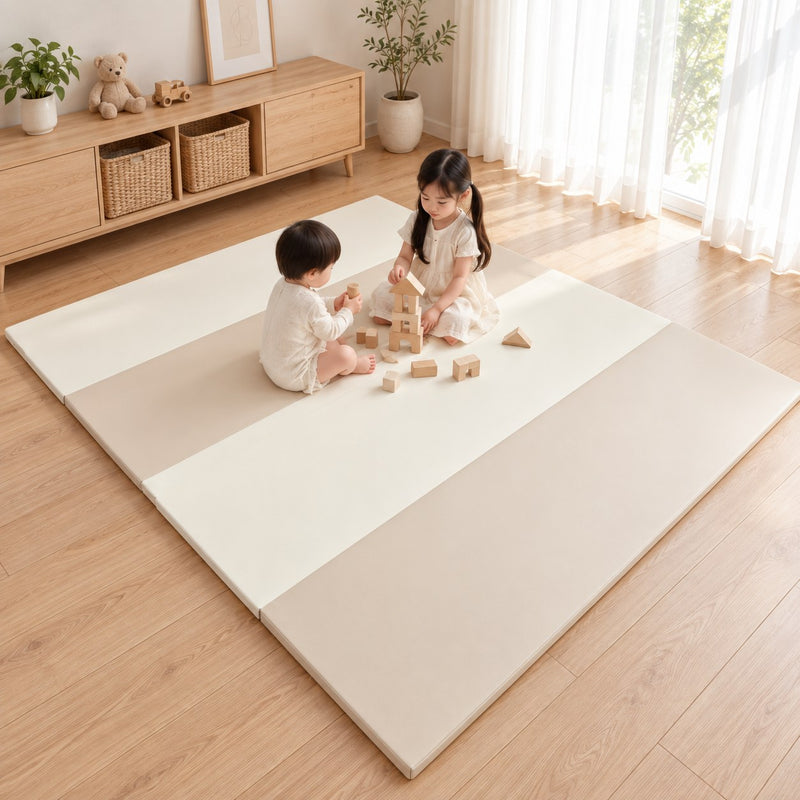
Premium
iXPE Premium
NT$ 3,580 – 5,880
Fine cells and fast rebound, absorbs more of every fall
4.5 cm thick · electron-cross-linked foam
4 sizes × 6 colours
Signature
POE Signature
NT$ 5,880 – 9,380
Soft yet springy, the most reassuring for the running and jumping years
4.5 cm thick · 99.84% high-purity silicone surface
4 sizes × 6 colours
Not sure which one?
Send us a photo
Send a photo of your living room plus your child's age and we will tell you straight away whether XPE or iXPE suits you better, and quote a custom size at the same time.
Add @anbibi on LINE →
Support hours 13:30–21:00 (closed weekends and public holidays)
Not on LINE? Email service@anbibi.com.tw instead